

 Suche
Suche
 Mein Konto
Two 20-year-olds charged in alleged $1.1 million NFT scam that defrauded investors
Ethan Vinh Nguyen and Andre Marcus Quiddaoen Llacuna have been charged with conspiracy to commit wire fraud and conspiracy to commit money laundering. The duo faces up to 20 years in prison, prosecutors say. The 20-year-old creators behind an alleged $1.1 million NFT scam were arrested on Thursday, just days before they launched another potential fraud scheme. Ethan Vinh Nguyen and Andre Marcus Quiddaoen Llacuna were charged with conspiracy to commit wire fraud and conspiracy to commit money laundering. The duo faces up to 20 years in prison, prosecutors said. In January, Blockworks first reported that operators of the non-fungible token (NFT) collection had called...
Two 20-year-olds charged in alleged $1.1 million NFT scam that defrauded investors

- Ethan Vinh Nguyen und Andre Marcus Quiddaoen Llacuna wurden wegen Verschwörung zum Drahtbetrug und zur Verschwörung zur Geldwäsche angeklagt
- Dem Duo drohen laut Staatsanwaltschaft bis zu 20 Jahre Haft
The 20-year-old creators behind an alleged $1.1 million NFT scam were arrested on Thursday - just days before they launched another potential fraud scheme.
Ethan Vinh Nguyen and Andre Marcus Quiddaoen Llacuna were charged with conspiracy to commit wire fraud and conspiracy to commit money laundering. The duo faces up to 20 years in prison prosecutors said.
In January, Blockworks first reported that operators of the non-fungible token (NFT) collection had called Frosties disappeared after investors poured over $1 million into the cartoon ice cream digital collectibles. The collection was robust, a crypto-native term for when a project's developers abandon ship after withdrawing investor funds and removing their liquidity.
Marcellus King, a first-time collector who lost about $3,000 in ether in the rug pull, told Blockworks he was “glad that justice has been served for these scammers.”
“I’m also glad others in this Wild West space that authorities are watching have been made aware,” King said.
“This will help bring more honesty and accountability to the NFT market.”
On January 9, after 8,888 Frostie NFTs were snapped up on the marketplace by OpenSea creators, shortly after Discord and Twitter were shut down. The project founders collected stolen funds and left after promising rewards such as “Staking Metaverse”. [and] breeding functions” as well as “[becoming] eligible for owner premiums,” says the project’s original website, which has since been taken down.
According to the developer's wallet address controllers, most of the originally stolen funds have been transferred Aether Scan.
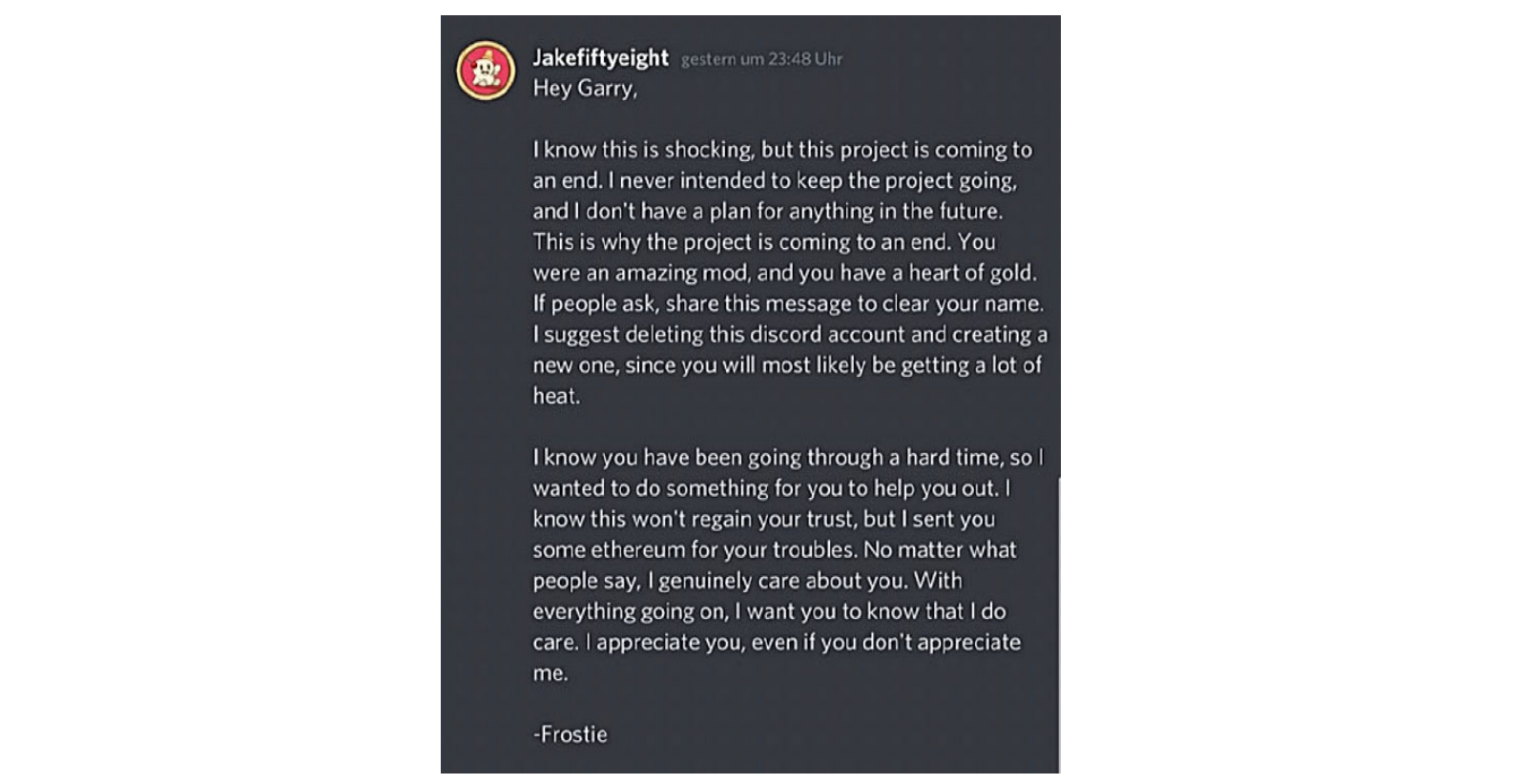
According to a criminal complaint, Nguyen confessed and apologized to a moderator of Frostie's community Discord server - sending the mod some ether "for [their] problems."
"I know this is shocking, but this project is coming to an end. I never intended to keep the project going and I have no plan for anything in the future," the message reads. "I want you to know that I care. I value you even if you don't value me."
The defendants also had plans for a follow-up NFT collection after diverting funds from their first project, according to the complaint.
The project, called Embers, was scheduled to launch on March 26 - two days after the duo's arrest. The project's revenue was estimated at around $1.5 million.
Ashley, a Frosties NFT holder, told Blockworks that the arrest “was a surprise” but that she had “always heard rumors [the project] was being investigated.”
“We hope this criminal case sets a precedent for anyone else who comes into the NFT space to defraud an innocent community,” said Ashley, who did not reveal her last name.
“It’s the first major crackdown in the NFT world, so scammers should take note.”
About 37% of all cryptocurrency fraud revenue comes from rug pulls — which netted $2.8 billion worth of crypto last year, according to a blockchain research firm Chain analysis.
“The trending market and demand for NFT investments has attracted the attention of not only real artists but also scammers,” said Ricky Patel, a special agent for Homeland Security Investigations, in a Expression. “[The two left] investors with empty pockets and no legitimate investment.”
. .
The post Two 20-Year-Olds Charged Over Alleged $1.1M NFT Scam, Defrauding Investors is not financial advice.